
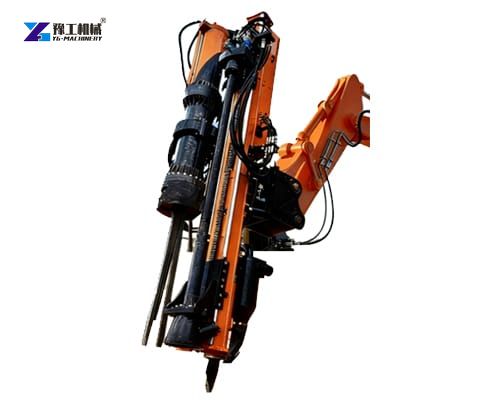
Rock drill and splitter is a dual-function attachment designed for excavators that first drills holes into the rock surface and then uses a splitting mechanism to fracture the material along predetermined planes. This combination of drilling and splitting in a single attachment eliminates the need for separate pieces of equipment, saving both time and labor costs. The machine works by first advancing a drilling head into the rock to create a pilot hole. Once the hole reaches the required depth, the attachment switches to splitting mode, where a wedge or piston is driven into the hole to generate immense lateral force, causing the rock to crack along natural fault lines or desired splitting lines. This method is exceptionally precise, allowing operators to control the direction and size of the rock fragments, which is critical when working near existing structures, underground utilities, or in urban environments where vibration and noise must be minimized.
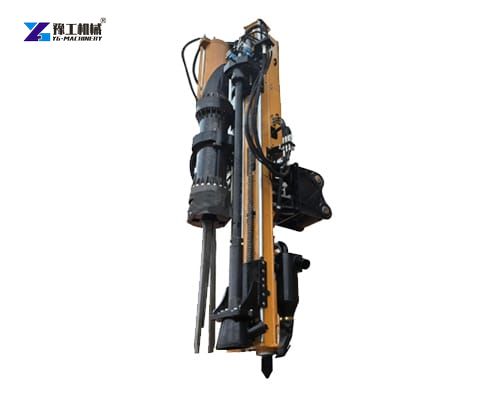
Rock Drill and Splitter Specifications
| Model | YG-130 | YG-152 | YG-210 |
| Suitable Excavator | 20T-36T Excavator | 36T-48T Excavator | 48T-65T Excavator |
| Maximum Horizontal Splitting Height | 9475mm | 9985mm | 10680mm |
| Maximum Vertical Splitting Height | 6715mm | 6905mm | 6770mm |
| Maximum Splitting Depth | 6705mm | 7025mm | 8050mm |
| Maximum Splitting Distance | 10225mm | 10875mm | 11640mm |
| Pilling Beam Length | 3875mm | 4850mm | 5525mm |
| Drilling Advance Stroke | 2000mm | 2600mm | 3500mm |
| Maximum Drilling Thrust Force | 50KN | 50KN | 50KN |
| Maximum Drilling Pull Force | 32KN | 32KN | 32KN |
| Piling Advance Stroke | 1500mm | 1800mm | 2300mm |
| Maximum Piling Thrust Force | 160KN | 160KN | 160KN |
| Maximum Piling Full Force | 100KN | 100KN | 100KN |
| Hydraulic Pressure | Max. 35Mpa | Max. 35Mpa | Max. 35Mpa |
| Hydraulic Flow | Min. 240L/min | Min. 240L/min | Min. 240L/min |
| Weight | 4200kg | 6200kg | 8300kg |
| Dimensions | 4210*1400*1785mm | 5270*1485*1840mm | 5810*1485*1840mm |
| Operation Mode | Remote Control | Remote Control | Remote Control |
Introduction to the YG Series Rock Drilling and Splitting Machine
The YG series rock drill and splitters are engineered to provide a reliable, high-performance solution for heavy-duty rock excavation. These attachments are manufactured with high-strength steel and precision components to withstand the extreme forces involved in drilling and splitting hard rock formations. Each model is tailored to a specific weight class of excavator, ensuring that hydraulic power is optimally matched to the attachment’s requirements. This matching is crucial because it prevents under-utilization or over-stressing of both the excavator and the attachment, leading to longer service life and more consistent operational results. All three models operate on a maximum hydraulic pressure of 35 MPa and require a minimum hydraulic flow of 240 liters per minute, which is standard for medium to large excavators. The remote control operation mode included with each unit enhances safety by allowing the operator to manage the drilling and splitting process from a safe distance, away from flying rock chips and potential machine kickback.
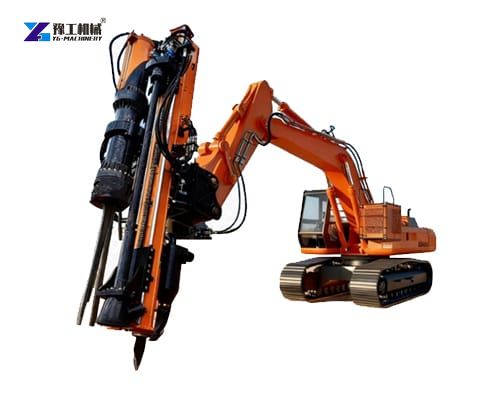
Primary Functions of the Excavator Rock Drilling and Splitting Attachment
The primary function of this attachment is to convert hydraulic power from your excavator into mechanical drilling and splitting action. In drilling mode, the rock drill and splitter uses a rotary-percussive mechanism to bore into the rock surface. The drilling advance stroke determines how deep the drill can penetrate in a single pass, with the YG-210 offering the deepest stroke at 3,500 mm. This stroke capability is essential for creating holes that are deep enough to accommodate the splitting wedge, ensuring that the fracture occurs at the desired depth. Once the hole is prepared, the machine switches to splitting mode without requiring the operator to reposition the excavator. The piling advance stroke then pushes the splitting tool into the hole, where it expands laterally to exert tremendous outward pressure against the hole walls. This pressure exceeds the tensile strength of most rock types, causing a clean, controlled split. The ability to perform both functions with a single attachment streamlines workflow, reduces cycle times, and minimizes the logistical complexity of having multiple tools on-site.
Another key function is the remote control operation, which provides a significant safety advantage. In traditional rock breaking methods, operators must be in close proximity to the working face, exposing them to hazards such as flying debris, dust inhalation, and equipment malfunction. With remote control, the operator can stand at a safe distance while maintaining full command of the drilling and splitting sequence. This feature also improves precision, as the operator can observe the rock’s response from multiple angles and adjust parameters such as thrust force or stroke speed in real time. The maximum hydraulic pressure of 35 MPa ensures that the attachment performs consistently even under heavy loads, while the minimum flow requirement of 240 L/min guarantees that the attachment is compatible with a wide range of excavator hydraulic systems. Whether you are drilling pilot holes for subsequent splitting or using the splitting function alone for secondary rock reduction, this attachment offers the versatility to handle multiple stages of the excavation process.
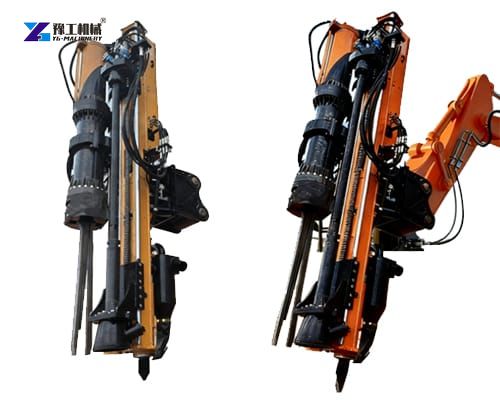
Common Application Scenarios
The rock drill and splitter fits a broad range of civil, mining and demolition projects.
Urban foundation excavation ranks among its most frequent use cases. Many city construction sites ban blasting due to nearby infrastructure, so this attachment breaks bedrock for building basements and subway pits with low vibration.
Quarry and stone mining sites deploy it to split large rock blocks, reducing waste compared with explosive blasting and keeping intact rock material for further processing.
Road widening and highway cutting projects use the unit to clear hard rock along route alignments, even in narrow working spaces.
Trenching work for pipelines and utility lines benefits from accurate rock splitting, creating clean trench walls without over‑breaking surrounding ground.
Mountain slope trimming and rock stabilization jobs also rely on this tool to remove unstable rock sections safely.
Smaller models suit mid‑size excavators for urban compact sites, while larger units pair with heavy‑duty excavators for open pit and high‑volume rock removal assignments.
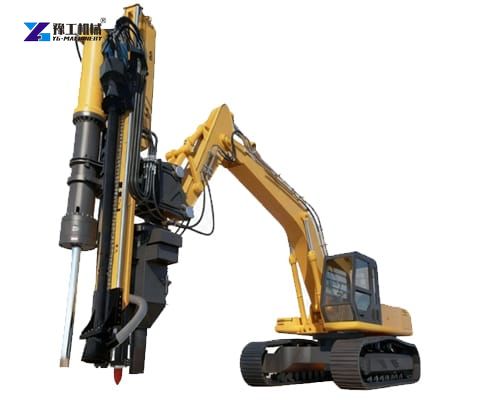
Key Advantages Summary
One major advantage of rock drill and splitter comes from combined two‑in‑one functionality. Contractors do not need buying separate drill rigs and splitters, cutting capital cost and site transport needs.
Compared with blasting, working noise and ground vibration stay at very low levels, reducing the risk of damage to adjacent structures, underground pipes, and overhead power lines.
Operators gain higher control over rock breaking outcomes. You can control where cracks form and manage block size, which helps produce usable rock material instead of fine rubble.
Remote‑controlled operation improves site safety significantly, keeping personnel away from potential rock fall zones. Compatibility with your current excavators removes pressure for big additional equipment investment.
Ready to Choose A Rock Drill and Splitter?
If you are ready to experience the benefits of an integrated rock drill and splitter, welcome to contact us today. We can help you evaluate your specific project requirements, assess your excavator’s compatibility, and recommend the ideal YG series model for your needs. Whether you need the compact agility of the YG-130, the balanced power of the YG-152, or the massive capacity of the YG-210, we have a solution tailored to your operation. We also offer comprehensive after-sales support, including spare parts availability, 24-hour online guidance, and on-site technical assistance. Reach out to us via email or WhatsApp, or fill out the inquiry form on our website, and we will respond promptly. We look forward to helping you to find a proper machine.