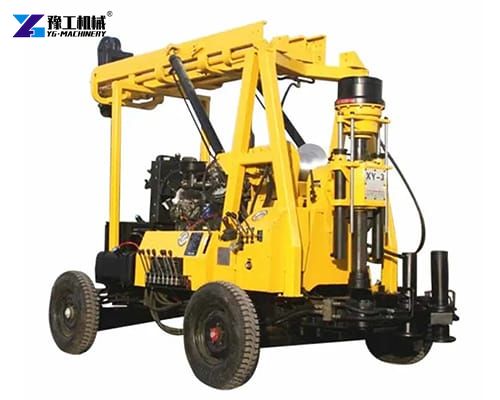
Reverse circulation drilling rig is a specialized machine designed to extract core samples or cuttings from boreholes while maintaining a closed-loop circulation system. Reverse circulation rigs use compressed air or fluids to force cuttings upward through the inner drill pipe. This unique mechanism ensures minimal contamination, faster sample retrieval, and enhanced operational efficiency. Reverse circulation drilling, commonly abbreviated as RC drilling, is a drilling technique renowned for its ability to deliver large, uncontaminated, and representative chip samples from great depths. Originally developed for mineral exploration in remote regions, these rigs have evolved to serve diverse sectors, including water resource management, environmental studies, and construction. Their ability to drill deep holes with high accuracy while minimizing environmental impact makes them a preferred choice for modern drilling projects.
Features Of A Reverse Circulation Drilling Rig
The RC drilling rig is characterized by a unique set of features that distinguish it from conventional rigs.
- Dual-Wall Drill Pipe System: The rig uses dual-wall drill pipes where the outer pipe directs compressed air downward, and the inner pipe transports rock cuttings upward.
- High Sampling Accuracy: Delivers uncontaminated samples directly from the cutting face.
- Rapid Penetration: Capable of drilling faster in hard rock formations compared to standard methods.
- Dust Control: Reduces dust emissions, making it suitable for environmentally sensitive areas.
- Durability: Built with heavy-duty components to withstand harsh mining and exploration conditions.
- Mobility: Available in truck-mounted, crawler-mounted, and trailer-mounted designs.
- Versatility: Can be adapted for deep mineral exploration, water wells, and large-diameter boreholes.
Main Components
The reverse circulation drilling rig consists of several key components that work together to deliver efficient drilling performance.
- Drill Mast
Provides structural support for the drilling process and guides the drill string vertically. - Dual-Wall Drill Pipe
A critical feature that allows for the separation of compressed air flow and sample return. - Drill Bit
Specialized RC drill bits are designed to handle tough geological formations. - Power Unit
Diesel engines or electric motors drive the rig, providing reliable energy for drilling operations. - Control Panel
Allows the operator to manage drilling speed, pressure, and other essential functions.
Advantages of the RC Drilling Method
- The most significant advantage is the superior sample quality and integrity. The closed inner tube retrieval system virtually eliminates contamination from the hole wall or upper sections of the hole. This provides geologists with a highly reliable sample, which translates to more accurate assay results and better resource modeling.
- Speed is another paramount advantage. RC drilling is significantly faster than most other drilling methods, particularly diamond core drilling. This rapid penetration rate, coupled with the continuous sampling process, allows for more meters drilled per shift, drastically reducing the time and cost required to complete a drilling program.
- This speed naturally leads to outstanding cost efficiency. Lower operational time means reduced labor and fuel costs. Furthermore, the larger sample size reduces the statistical error in assaying, potentially saving a lot of misclassified ore and waste.
How Does A Reverse Circulation Drilling Rig Work?
The principle of reverse circulation is elegantly simple, but its execution is a feat of engineering. The process begins with the compressor generating a continuous stream of high-pressure air. This air is directed down the annulus, the space between the outer and inner tubes of the dual-wall drill pipe.
The air travels down the column until it reaches the RC hammer at the bottom of the hole. Here, the air energizes the hammer, causing it to percussively punch the tungsten carbide buttons on the drill bit into the rock formation, breaking it apart. Once the air has done its job powering the hammer, it must return to the surface. Instead of traveling back up the hole wall where it could mix with collapsing material or surface contaminants, it is forced to take a different path.
The used air, now laden with the freshly created rock cuttings, is immediately forced through the sample uptake hole and into the inner tube of the drill pipe. This creates a continuous vacuum effect, efficiently sucking the cuttings from the face of the hole. The air and cuttings mixture then travels at high velocity up the protected inner tube, ensuring a completely segregated journey to the surface.
Upon arrival at the rig, the mixture is routed into the cyclone. The cyclone spins the mixture, forcing the dense cuttings to the walls where they fall out the bottom into sample bags, while the cleaned air is expelled from the top, often through a dust suppression system. This process provides a continuous, depth specific sample that is highly representative of the formation being drilled.