
Hydraulic core drilling rig is specialized drilling equipment designed to recover cylindrical rock samples from underground formations. Mining companies, geological survey contractors, exploration teams, and engineering consultants use these samples to evaluate mineralization, rock structure, and subsurface conditions. Core drilling preserves a continuous section of rock for geological logging and laboratory analysis. The quality of the recovered core can influence resource evaluation, exploration decisions, and subsequent project planning. The hydraulic core drilling machine uses hydraulic power to control rotation, feed pressure, and lifting operations. Depending on the model, the equipment may incorporate a hydraulic power head, wireline core retrieval system, mast, drill rod handling components, winch, and tracked or skid-mounted chassis.
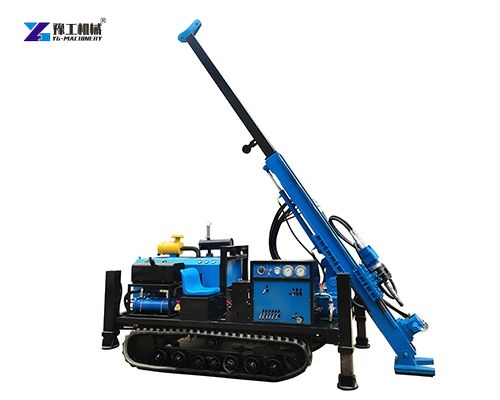
Specifications of the Hydraulic Core Drilling Rig
| Model | YG-400 | YG-600 | YG-800 | YG-1000 | YG-1200 | YG-1500 | YG-2000 | |
| Drilling Capacity | Caliber | HTW-NTW-BTW | ||||||
| Depth | 200-400-500 (M) | 350-700-800 (M) | 400-900-1000 (M) | 500-1100-1400 (M) | 500-1200-1500 (M) | 500-1500-1800 (M) | 1000-2000-2500 (M) | |
| Hydraulic System | Rated Pressure | 20 (MPA) | 20 (MPA) | 28 (MPA) | 28 (MPA) | 28 (MPA) | 28 (MPA) | 28 (MPA) |
| Rated Flow Rate | 160 (L/min) | 220 (L/min) | 280 (L/min) | 300 (L/min) | 330 (L/min) | 350 (L/min) | 460 (L/min) | |
| Heat Dissipation Method | Air cooling | |||||||
| Engine | Brand | Yuchai | ||||||
| Type | Turbocharged | |||||||
| Rated Speed | 2400 (RPM) | |||||||
| Rated Power | 70 (KW) | 92 (KW 6-cylinder) | 118 (KW 6-cylinder) | 118 (KW 6-cylinder) | 140 (KW 6-cylinder) | 150 (KW 6-cylinder) | 162 (KW 6-cylinder) | |
| Drilling System | Torque | 350-700 (N.M) | 450-1300 (N.M) | 450-2200 (N.M) | 1000-3500 (N.M) | 1000-3800 (N.M) | 1000-4000 (N.M) | 1000-6400 (N.M) |
| Speed | 1300 (RPM) | 1300 (RPM) | 1300 (RPM) | 1300 (RPM) | 1300 (RPM) | 1300 (RPM) | 1100 (RPM) | |
| Tower Type | Integrated ground contact type | |||||||
| Go Ahead with the Process | 1900 (MM) | 1900 (MM) | 2400 (MM) | 3500 (MM) | 3500 (MM) | 3500 (MM) | 3800 (MM) | |
| Drilling Tower Angle | 45-90 (°) | |||||||
| Boosting Power | 14 (T) | 16 (T) | 24 (T) | 28 (T) | 30 (T) | 36 (T) | 40 (T) | |
| Give in Strength | 7 (T) | 8 (T) | 12 (T) | 14 (T) | 15 (T) | 18 (T) | 20 (T) | |
| Transmission Type | Direct connection box | Gear box | Variable speed gear box | |||||
| Rope Hoist | Boosting Power | 600 (KG) | 600 (KG) | 800 (KG) | 1000 (KG) | 1000/8000 (KG) | 1000/10000 (KG) | 1000/15000 (KG) |
| Speed | 100-300 (RPM) | 100-300 (RPM) | 100-300 (RPM) | 100-300 (RPM) | 100-300/0-50 (RPM) | 100-300/0-50 (RPM) | 100-400/0-50 (RPM) | |
| Steel Wire Rope Diameter | 6 (MM) | 6 (MM) | 6 (MM) | 6 (MM) | 6/16 (MM) | 6/18 (MM) | 6/24 (MM) | |
| Rope Capacity | 600 (M) | 700 (M) | 900 (M) | 1100 (M) | 1200/40 (M) | 1500/50 (M) | 2000/45 (M) | |
| Walking System | Operation Type | Manual + Remote control | ||||||
| Walking Speed | 3.5 (KM/H) | 3.5 (KM/H) | 3.5 (KM/H) | 3.5 (KM/H) | 3.5 (KM/H) | 3.5 (KM/H) | 3.5 (KM/H) | |
| Climbing Angle | 40 (°) | 40 (°) | 40 (°) | 40 (°) | 40 (°) | 40 (°) | 40 (°) | |
| Mud Pump | Model | BW-100 | BW-120 | BW-150 | BW-150 | BW-200 | BW-250 | BW-320 |
| Flow | 0-100 (L/MIN) | 0-120 (L/MIN) | 0-150 (L/MIN) | 0-150 (L/MIN) | 0-200 (L/MIN) | 0-250 (L/MIN) | 0-320 (L/MIN) | |
| Pressure | 0-7 (MPA) | 0-7 (MPA) | 0-7 (MPA) | 0-7 (MPA) | 0-10 (MPA) | 0-10 (MPA) | 0-10 (MPA) | |
| Hydraulic Generator | Type | Variable frequency, brushless and maintenance-free | ||||||
| Power & Voltage | 11KW 220V/380V | |||||||
| Size & Weight | Transport Size | 4200*2050*2300 (MM) | 4200*2050*2300 (MM) | 4900*2100*2360 (MM) | 6000*2100*2400 (MM) | 6000*2100*2400 (MM) | 6000*2100*2400 (MM) | 6293*2210*2762 (MM) |
| Whole Machine Weight | 4.3 (T) | 5.6 (T) | 7 (T) | 8.5 (T) | 9.5 (T) | 10.5 (T) | 12.7 (T) | |
Contact Us for A Suitable Model
Technical Advantages of a Hydraulic Core Drilling Rig
1. Controlled Hydraulic Feed
Hydraulic feed allows the operator to regulate the force applied to the drill bit. This is important when drilling through alternating hard and fractured formations, where excessive pressure can accelerate bit wear, damage the core, or increase the risk of drill string sticking.
An appropriately sized hydraulic cylinder and control valve arrangement help maintain a more consistent feed rate under changing ground conditions.
2. Adjustable Rotation and Torque
Drilling speed and torque requirements vary with rock hardness, bit diameter, and drilling depth. A suitable rotary drive must provide enough torque for difficult formations while maintaining the rotational speed required by the selected bit.
Variable hydraulic control can help operators adjust the drilling process without relying exclusively on fixed mechanical speed settings. Actual performance depends on pump capacity, motor displacement, transmission design, and operating pressure.
3. Efficient Core Retrieval
When equipped with a compatible wireline system, the rig can retrieve an inner core barrel without withdrawing the entire drill string. This reduces the need for repeated rod handling and can improve productive drilling time, particularly in deeper exploration holes.
However, wireline equipment must match the selected core barrel and drill rod system. BQ, NQ, HQ, and PQ configurations are not interchangeable without checking dimensional and tooling compatibility.
Configuration and Main Components
A hydraulic core drilling rig should be evaluated as a complete drilling system rather than as an isolated engine or power head.
Power Unit
The engine or electric motor supplies the energy required by the hydraulic system. Buyers should verify rated power, operating speed, fuel consumption or electrical requirements, and suitability for the intended working environment.
Diesel power is often practical at remote exploration sites without reliable electricity. Electric configurations may suit mines, workshops, or projects where an appropriate power supply is available.
Hydraulic Pump and Control Valves
The pump converts mechanical input into hydraulic flow and pressure. Flow primarily influences actuator speed, while pressure determines the available force or torque within the limits of the hydraulic components.
Rotary Head and Feed Mechanism
The rotary head transfers torque to the drill string. Its maximum torque, speed range, feed stroke, lifting capacity, and spindle opening influence the tooling that can be used and the way drilling operations are managed.
Mast, Winch, and Rod Handling
The mast supports the drill string during drilling and lifting. The winch provides the lifting force required for applicable handling operations, while clamps or hydraulic chucks secure the rods.
Mud Pump and Circulation Equipment
Drilling fluid carries cuttings away from the bit, cools the cutting surface, and helps stabilize the borehole when the selected drilling method requires circulation.
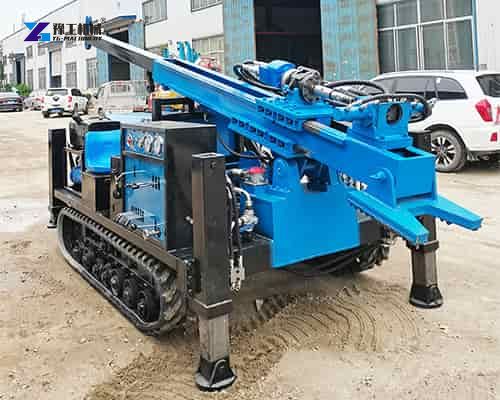
How Does a Hydraulic Core Drilling Rig Work?
The drilling process begins with positioning and stabilizing the rig. The operator aligns the mast with the planned borehole direction, checks the hydraulic system, connects the drilling tools, and establishes the required circulation arrangement.
Once drilling starts, the power unit drives the hydraulic pump. Pressurized oil flows through the control valves to the rotary motor and feed cylinder. The rotary motor turns the drill string, while the feed mechanism applies controlled downward force.
At the bottom of the hole, a suitable core bit cuts an annular path through the formation. The resulting cylindrical rock sample enters the inner core barrel. Drilling fluid, where required, transports cuttings away from the bit and supports the drilling process.
When the core barrel reaches its capacity, the operator follows the retrieval procedure for the selected system. With a compatible wireline arrangement, the inner barrel can be recovered through the drill string while most of the rods remain in the borehole.
The recovered core is then removed, documented, and prepared for geological inspection. Drilling resumes after the barrel is reassembled and returned to the required position.
Correct feed pressure, rotational speed, circulation, and retrieval procedures are essential. These operating variables should be adjusted according to formation conditions and the equipment manufacturer’s instructions.
Main Applications Across Industries
- Mineral Exploration
Mining and exploration companies use hydraulic core drilling rigs to investigate ore bodies, establish geological continuity, and obtain samples for laboratory testing. Deeper projects may require wireline systems, stronger lifting capacity, and larger power units. - Geological Surveying
Geological contractors use core samples to examine rock layers, faults, weathering zones, and formation boundaries. Adjustable drilling parameters help accommodate changes in ground conditions along a borehole. - Geotechnical Investigation
Infrastructure and construction projects may require boreholes to assess rock quality, foundation conditions, and subsurface stability. The rig configuration should reflect the required sample diameter, investigation depth, and project-specific sampling procedures. - Mining Support and Underground Applications
Specialized hydraulic rigs can be configured for underground exploration, depending on equipment dimensions, ventilation requirements, drilling orientation, and site restrictions. Surface rigs should not be assumed suitable for underground operation without confirming the relevant configuration and safety requirements.
Frequently Asked Questions
Q1: What is the main advantage of a hydraulic core drilling rig?
Its main advantage is the ability to control drilling feed and rotation through a hydraulic system. With suitable tooling and operating procedures, this supports controlled penetration and the recovery of geological core samples.
Q2: How deep can a hydraulic core drilling rig drill?
Drilling depth depends on the model, core size, rod system, formation conditions, and drilling method.
Q3: What is the difference between a hydraulic core drilling rig and a water well drilling rig?
A core drilling rig is designed to recover rock samples for geological or engineering analysis. A water well drilling rig generally prioritizes borehole construction and water access.