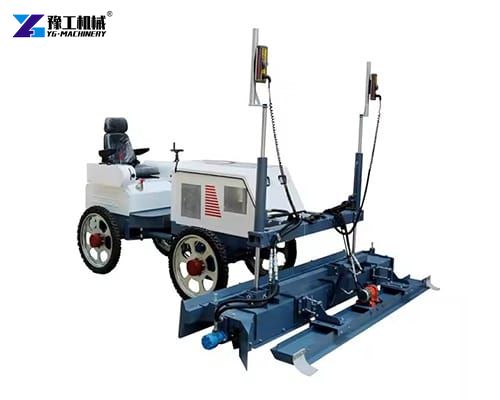
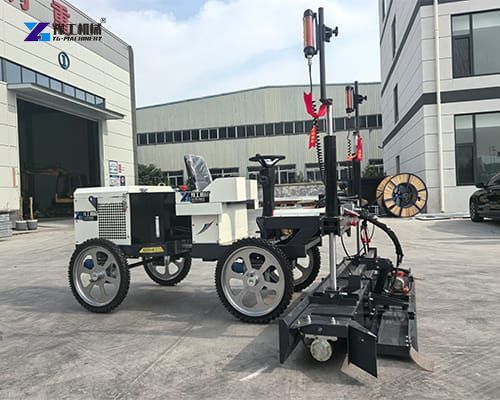
Concrete laser leveling machine uses a laser reference system, electronic control, and a hydraulically operated leveling assembly to help contractors achieve controlled concrete surface elevations. Depending on the configuration, the machine can also integrate a vibrating plate to support concrete consolidation and improve surface uniformity. Our YG-CL300, YG-CL300A, YG-ZP30, and YG-ZP40 models cover different working widths, power requirements, slab thickness ranges, and site conditions. The range includes compact gasoline-powered equipment for smaller projects and heavier diesel-powered machines designed for larger concrete placement operations. The right model depends on slab dimensions, concrete consistency, required surface tolerances, site access, available labor, and daily production targets.
Concrete Laser Leveling Machine Specifications
| Model | YG-CL300 | YG-CL300A | YG-ZP30 | YG-ZP40 |
| Engine model | Briggs & Stratton 38E3/LONCIN/Honda 690 (optional) | Briggs & Stratton 38E3/LONCIN/Honda 690 (optional) | Yanmar 4TNV94L | Yanmar 4TNV98L |
| Engine type | Gasoline, air-cooled 4-stroke, twin-cylinder engine | Gasoline, air-cooled 4-stroke, twin-cylinder engine | Diesel | Diesel |
| Engine power | 22KW/30ps | 22.8KW/23ps/31ps | 35.5KW/48hp | 63.9KW/86hp |
| Fuel tank volume | 20L (operation time is about 8 hours | 20L (operation time is about 8 hours | 100L | 140L |
| Hydraulic oil volume | 37L | 35L | 150L | 200L |
| Laser transmitter | Swiss Leica/Tower transmitter (optional) | Swiss Leica/Tower transmitter (optional) | American Tempo | American Tempo |
| Laser receiver | Swiss Leica/Tower receiver (optional) | Swiss Leica/Tower receiver (optional) | German Mopar | German Mopar |
| Laser system control effect | Plane, slope, double slope (three-dimensional) |
Plane, slope, double slope (three-dimensional) |
Flat, inclined or double slope (3D) | Flat, inclined or double slope (3D) |
| Laser system control method | Microcomputer laser scanning | Microcomputer laser scanning | Microcomputer laser scanning | Microcomputer laser scanning |
| Paving method | Hydraulic stirring cage paving | Hydraulic stirring cage paving | Hydraulic Cage Paving | Hydraulic Cage Paving |
| Vibration plate width | 2500mm | 3000mm | 3100mm | 4000mm |
| Leveling thickness | 50-300mm | 60-300mm | 100-450mm | 100-500mm |
| Walking drive form | Reducer motor integrated | Reducer motor integrated | Hydraulic four-wheel drive Outrigger |
Hydraulic four-wheel drive Outrigger |
| Working speed | 0-4Km/h (speed adjustable) | 0-4Km/h (speed adjustable) | 4-8km/h 24m/min | 4-8km/h 24m2/min |
| Walking tires | Solid anti-skid and anti-puncture tires (optional wide tires) | Solid anti-skid and anti-puncture tires (optional wide tires) | Front wheel + four wheels + crab walk | Front wheel + four wheels + crab walk |
| Body size | 3250x2850x1320mm | 3300x3460x1650mm | 5350x3650x2040mm | 5495x4555x2630mm |
| Weight | 900kg | 1000kg | 5500 kg | 8500 kg |
| Vibration method/excitation force | Hydraulic vibration/2000N | Hydraulic vibration/2000N | / | / |
| Hydraulic system | / | / | Danfoss | Danfoss |
| Auger power | / | / | Hydraulic motor | Hydraulic motor |
| Steering method | / | / | One-touch four-leg self-leveling | One-touch four-leg self-leveling |
| Cleaning machine flow | / | / | 15L/min | 15L/min |
| Advantages of Jiaobanlong | / | / | Flip up and down for easy cleaning, left and right switching, blades made of highly wear-resistant material, more durable | Flip up and down for easy cleaning, left and right switching, blades made of highly wear-resistant material, more durable |
| Reach length | / | / | 6000mm | 6000mm |
Model Configurations of the Concrete Laser Screed Machine
The working table defines four concrete laser leveling machine families across gasoline and diesel power, with working widths from 2.5 m to 4.0 m and different travel systems. Those differences are not cosmetic. They map directly to jobsite conditions.
1. Gasoline-powered ride-on configurations (YG-CL300 and YG-CL300A).
These models use Briggs & Stratton or Honda gasoline engines, with Leica or Tower laser systems optional. The 2.5 m and 3.0 m screed widths make them suitable for medium-bay warehouses, workshops, and sites where diesel fuel logistics are inconvenient. Fuel consumption is modest, and the 20 L tank supports roughly eight hours of operation. The trade-off is output ceiling: a 2.5 m head covers less area per pass than a 4.0 m head, so pour planning must match concrete delivery rate to machine cycle time. These models are often the right entry point for contractors moving from manual screeding to laser-guided placement without committing to a large-format machine.
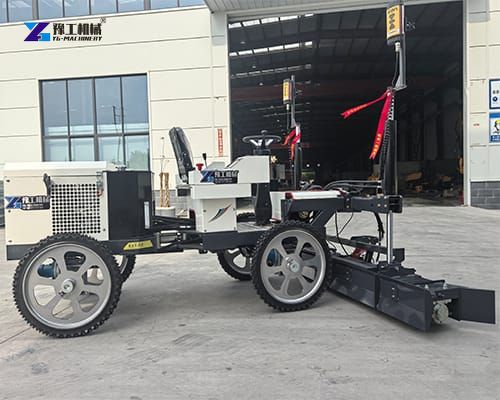
2. Diesel-powered ride-on configurations (YG-ZP30 and YG-ZP40).
The Yanmar 4TNV94L and 4TNV98L engines, 100–140 L fuel tanks, and 3.1–4.0 m working widths place these machines in the high-output category. The hydraulic four-wheel drive with crab walk and outrigger support allows the operator to reposition without damaging fresh concrete edges. The YG-ZP40’s 4.0 m head is specified for large-bay logistics floors and industrial slabs where minimizing pass count directly reduces joint layout complexity. Both models use Danfoss hydraulic systems and one-touch four-leg self-leveling, features that matter on sites where setup time consumes a significant portion of the shift.
The choice between gasoline and diesel is not about power alone. It is about fuel access, emissions requirements at the destination market, and the service network available for the specific engine.
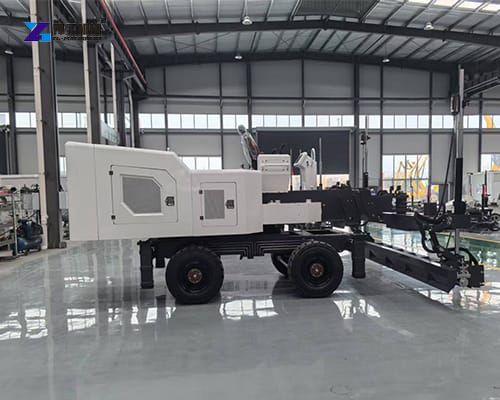
Core Technical Advantages of the Laser-Guided Concrete Leveling Equipment
1. Laser-Guided Elevation Control
The concrete laser leveling machine uses a laser transmitter and receiver to establish a reference elevation. The receiver communicates with the control system, allowing the leveling assembly to adjust its working position according to the configured control mode.
Depending on the selected model and laser system, supported control applications include flat surfaces, single slopes, and double slopes. Three-dimensional slope control can be available where the compatible configuration supports it.
2. Hydraulic Leveling and Vibration
The YG-CL300 and YG-CL300A use hydraulic leveling assemblies with a reported hydraulic vibration force of 2,000 N. Their vibrating plates measure 2,500 mm and 3,000 mm wide, respectively.
The YG-ZP30 and YG-ZP40 use hydraulic cage paving systems and wider working plates of 3,100 mm and 4,000 mm. These configurations are intended for larger working areas where a wider leveling assembly can help reduce the number of passes.
3. Hydraulic Mobility and Site Maneuverability
The larger YG-ZP30 and YG-ZP40 feature hydraulic four-wheel drive, an outrigger configuration, and a crab-walk steering arrangement. These features support maneuvering and positioning on suitable, prepared work surfaces.
Their reported travel speed is 4–8 km/h, compared with 0–4 km/h for the compact YG-CL300 series. Actual travel speed and productivity depend on site conditions and operating procedures.
How Does a Concrete Laser Leveling Machine Work?
The leveling process starts by establishing the required elevation or slope using a compatible laser transmitter. The laser receiver detects the reference signal and sends information to the machine’s control system.
The electronic controller uses this reference to regulate the height of the leveling assembly. The operator positions the machine over the placed concrete and moves it across the working area according to the recommended operating procedure.
On configurations equipped with hydraulic vibration, the vibrating plate works across the concrete surface while the leveling mechanism follows the established reference. This combination helps control elevation and supports a more consistent surface.
The operator remains responsible for monitoring concrete supply, machine movement, slab edges, joints, obstacles, and changing site conditions. Proper preparation and a suitable concrete mix remain essential for achieving the specified finish.
For best results, contractors should calibrate the laser system, verify the reference elevation, inspect the leveling assembly, and conduct a test pass before starting full production.
Concrete Floor Leveling Machine Applications
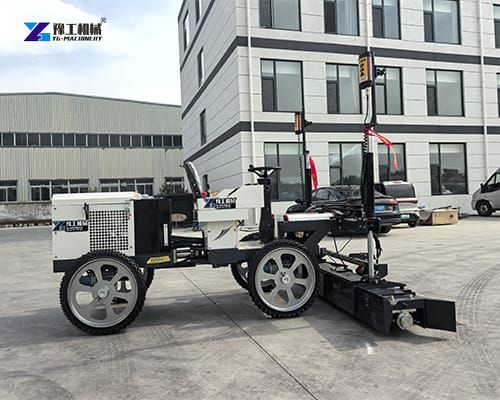
A laser screed machine can be used for a range of concrete floor and slab projects, provided the selected configuration matches the application.
Warehouse and Distribution Center Floors
Large warehouses require consistent floor elevations to support storage systems, material-handling equipment, and daily logistics operations. Wider working plates may be beneficial when placing extensive floor areas.
Industrial Workshop Slabs
Manufacturing facilities often require durable concrete floors with defined elevation and slope requirements. Diesel-powered models can be considered for larger slab operations, subject to site access and concrete specifications.
Commercial Buildings and Parking Areas
The compact YG-CL300 and YG-CL300A may be suitable for projects where working width, maneuverability, and equipment transport are important considerations. Sloped surfaces require a compatible control configuration.
Large Concrete Placement Projects
The YG-ZP30 and YG-ZP40 are intended for larger-scale applications where their higher engine output, wider plates, and hydraulic mobility may support demanding work schedules.
The final choice should be based on the required floor tolerance, concrete depth, site geometry, and contractor experience rather than machine size alone.
Frequently Asked Questions about the Automatic Laser Concrete Screed
Q1: What is a concrete laser leveling machine used for?
The concrete laser screed machine controls the elevation of freshly placed concrete using a laser reference and an electronically controlled leveling assembly. Depending on its configuration, it may also use hydraulic vibration to support concrete consolidation and surface uniformity.
Q2: What is the difference between YG-CL300 and YG-CL300A?
The YG-CL300 has a 2,500 mm vibrating plate and weighs approximately 900 kg. The YG-CL300A has a 3,000 mm plate and weighs approximately 1,000 kg. Their listed leveling thickness ranges are 50–300 mm and 60–300 mm, respectively.
Q3: Which model is suitable for large warehouse floors?
The YG-ZP30 and YG-ZP40 are candidates for large floor projects because they have diesel engines, wider plates, and hydraulic mobility systems. The final selection depends on floor specifications, site access, production requirements, and transport limitations.
Q4: Can these machines level sloped concrete surfaces?
The supplied specifications list flat, single-slope, and double-slope control functions. Confirm the exact three-dimensional control capability, laser compatibility, and included accessories for the selected model before ordering.
Q5: What is the maximum listed leveling thickness?
The YG-CL300 and YG-CL300A list maximum thicknesses of 300 mm. The YG-ZP30 lists 450 mm, while the YG-ZP40 lists 500 mm. These figures represent the supplied equipment specifications and should be validated for the intended concrete mix and working conditions.
Q6: How do I choose between gasoline and diesel models?
Gasoline models may suit projects where compact dimensions and lighter equipment are priorities. Diesel models offer greater engine output and wider working plates for larger operations. Consider site conditions, operating hours, fuel availability, maintenance support, and total ownership cost.