
Hydraulic rock drill and splitter is an excavator attachment engineered to execute two distinct mechanical steps using a single carrier: drilling precise blast-free pilot holes into solid rock and immediately driving a heavy wedge set into the hole to induce tensile fractures. This dual-function unit utilizes controlled hydraulic forces. It operates by delivering up to 35 MPa of oil pressure to drive a top-hammer rock drill for bore penetration, followed by a hydraulic cylinder driving hardened counter-wedges to expand the rock beyond its ultimate tensile strength.
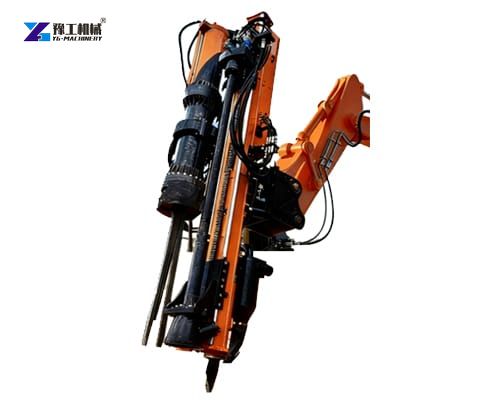
Integrated Rock Drill and Splitter Parameters
| Model | YG-130 | YG-152 | YG-210 |
| Suitable Excavator | 20T-36T Excavator | 36T-48T Excavator | 48T-65T Excavator |
| Maximum Horizontal Splitting Height | 9475mm | 9985mm | 10680mm |
| Maximum Vertical Splitting Height | 6715mm | 6905mm | 6770mm |
| Maximum Splitting Depth | 6705mm | 7025mm | 8050mm |
| Maximum Splitting Distance | 10225mm | 10875mm | 11640mm |
| Pilling Beam Length | 3875mm | 4850mm | 5525mm |
| Drilling Advance Stroke | 2000mm | 2600mm | 3500mm |
| Maximum Drilling Thrust Force | 50KN | 50KN | 50KN |
| Maximum Drilling Pull Force | 32KN | 32KN | 32KN |
| Piling Advance Stroke | 1500mm | 1800mm | 2300mm |
| Maximum Piling Thrust Force | 160KN | 160KN | 160KN |
| Maximum Piling Full Force | 100KN | 100KN | 100KN |
| Hydraulic Pressure | Max. 35Mpa | Max. 35Mpa | Max. 35Mpa |
| Hydraulic Flow | Min. 240L/min | Min. 240L/min | Min. 240L/min |
| Weight | 4200kg | 6200kg | 8300kg |
| Dimensions | 4210*1400*1785mm | 5270*1485*1840mm | 5810*1485*1840mm |
| Operation Mode | Remote Control | Remote Control | Remote Control |
Hydraulic Rock Drill and Splitter Advantages
The data table provided reveals the meticulous engineering behind each model. Below is an in-depth analysis of the performance metrics that matter most to end-users.
1. Suitable Excavator Matching
YG-130: Optimized for 20T–36T excavators.
YG-152: Designed for 36T–48T excavators.
YG-210: Built for the largest carriers, 48T–65T excavators.
Proper matching is critical. An undersized attachment will lack the necessary hydraulic flow (minimum 240L/min required for all models), while an oversized unit may compromise the carrier’s stability and boom stress. The YG series ensures that the splitter’s maximum thrust and pulling forces are fully utilized without straining the host machine.
2. Dimensional Reach and Splitting Geometry
The physical dimensions dictate how deep and wide the machine can work:
Maximum Splitting Height (Horizontal): Ranges from 9,475mm (YG-130) to 10,680mm (YG-210). This vertical reach allows operators to tackle high walls without repositioning the excavator.
Maximum Vertical Splitting Height: Between 6,715mm and 6,905mm. This parameter is crucial for undercutting and slope stabilization.
Maximum Splitting Depth: The YG-210 achieves a depth of 8,050mm, significantly outperforming the YG-130’s 6,705mm. This depth capability is directly correlated to piling beam length (5,525mm for the YG-210), allowing deeper foundation work in a single pass.
Maximum Splitting Distance: At 11,640mm, the YG-210 offers the broadest horizontal spread, reducing the number of repositioning cycles required on large sites.
3. Drilling and Piling Stroke Dynamics
Drilling Advance Stroke: This ranges from 2,000mm to 3,500mm. A longer stroke (YG-210) means the drill rod can penetrate deeper before needing an extension change, increasing overall drilling speed.
Piling Advance Stroke: The piling (or pushing) stroke ranges from 1,500mm to 2,300mm. This stroke determines how far the splitter wedges can be advanced into the pre-drilled hole, directly impacting the splitting force applied to the rock.
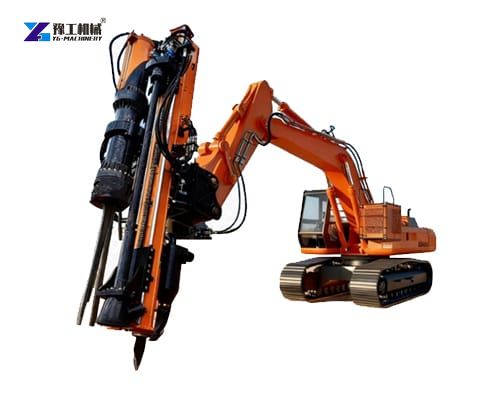
Drilling Force vs. Splitting Force: The Technical Data Analysis
One of the most remarkable aspects of the YG hydraulic rock drill and splitter is the uniformity in force parameters across all models:
Maximum Drilling Thrust Force: 50 KN (all models)
Maximum Drilling Pull Force: 32 KN (all models)
Maximum Piling Thrust Force: 160 KN (all models)
Maximum Piling Pull Force: 100 KN (all models)
While the weights and dimensions differ, the hydraulic force generated remains consistent. This design philosophy ensures that even the smaller YG-130 delivers the same drilling penetration rate as the larger units, provided the excavator’s hydraulic flow remains constant. The key differentiator is the stroke length and structural robustness required to handle large-diameter tools and deeper holes.
Technical Insight: The drilling pull force (32KN) is critical for retracting the drill string from fractured zones. High pull force prevents the drill bit from getting stuck in crushed debris, a common failure point in lesser-engineered attachments. Similarly, the piling thrust force (160KN) ensures that the splitter wedges can overcome the tensile strength of the hardest granites and basalts.
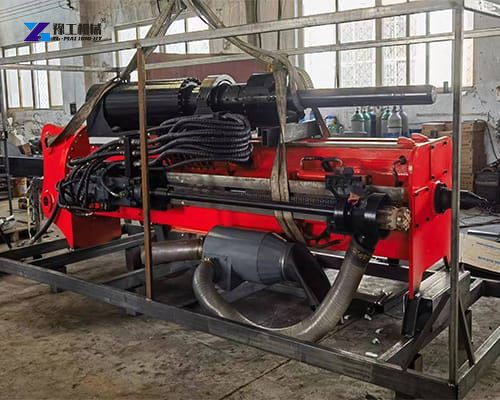
Main Industry Applications of Hydraulic Rock Drill and Splitter
Urban Infrastructure & Foundation Excavation: Operating adjacent to historic structures, utility mains, or residential zones where blasting is prohibited and impact hammers exceed decibel limits.
Trenching & Pipeline Channeling: Cutting clean, square channels through granite, basalt, or reinforced concrete without micro-fracturing surrounding rock walls.
Dimensional Stone Quarrying: Splitting large marble, granite, or sandstone blocks without causing internal micro-cracks, preserving commercial stone value.
Tunneling & Shaft Sinking: Bench extraction and perimeter trimming where explosives pose containment risks or ventilation limitations.
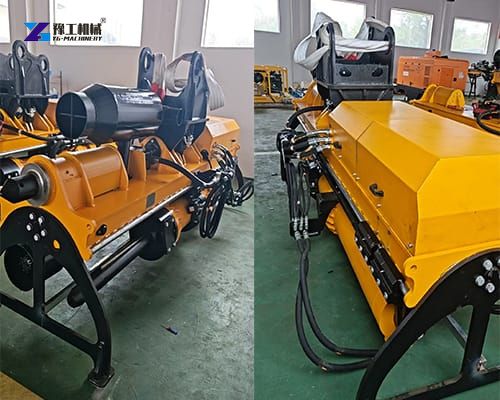
Step-by-Step Operating Principle
The primary rock-breaking sequence by hydraulic rock drill and splitter follows four engineered stages:
Positioning and Anchoring: The operator positions the excavator boom, placing the guide beam firmly against the rock face at the calculated burden distance.
Automated Borehole Drilling: The hydraulic rock drill engages, driving a tungsten-carbide button bit into the rock. Air or water flushing clears dust from the hole. Standard drilling stroke varies between 2,000 mm and 3,500 mm depending on attachment size.
Indexing and Wedge Insertion: Once target borehole depth is reached, the beam indexing mechanism aligns the hydraulic splitter over the freshly drilled hole. The splitter cylinder lowers the center wedge and counter-wedges into the cavity.
Hydraulic Splitting & Block Displacement: High-pressure hydraulic oil drives the main cylinder forward. The center wedge forces the outer counter-wedges outward against the borehole walls. Tensile stress rapidly exceeds the tensile limit of the rock, inducing a clean crack along the splitting plane within 15 to 30 seconds.
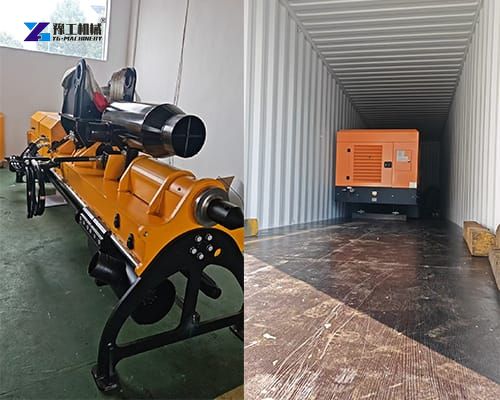
Hydraulic Integrated Rock Drill and Splitter for Sale in YG Machinery
Investing in a high-quality hydraulic rock drill and splitter is a strategic decision that enhances project safety, reduces environmental impact, and lowers operational costs. The YG-130, YG-152, and YG-210 models offer a scalable solution for contractors managing medium to heavy-duty excavation tasks. By focusing on the core parameters—excavator compatibility, stroke length, and splitting geometry—you can match the attachment to your specific conditions. For more details about the equipment, please contact us freely.